
Metal Roof vs. Tile Roof in South Florida: Which Lasts Longer and Costs Less?
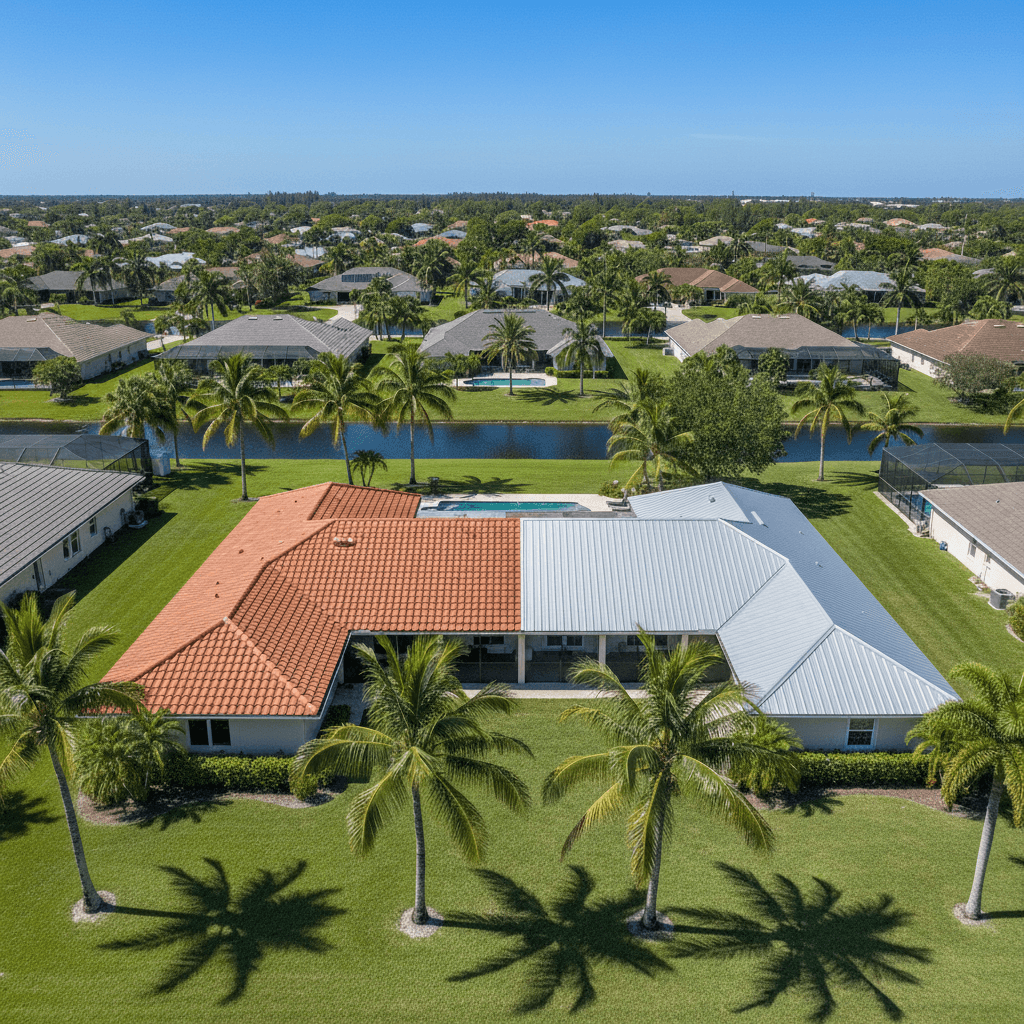
South Florida homeowners replacing a roof face one decision above all others: metal or tile? Both are common on Florida homes. Both are built for the heat. But they perform differently over time
Overview
South Florida homeowners replacing a roof face one decision above all others: metal or tile?
Both are common on Florida homes. Both are built for the heat. But they perform differently over time — and the right answer depends on your home, your budget, and how long you plan to stay.
This guide walks you through a direct comparison, with real cost data for Miami-Dade, Broward, and Palm Beach homeowners.
How Metal Roofs Perform in South Florida
Standing seam metal and metal panel systems are among the most durable roofing options in Florida. Here's what the data shows:
Lifespan: 40–70 years in a South Florida climate when properly installed and maintained. This is roughly double the lifespan of an asphalt shingle roof.
Wind resistance: Most Miami-Dade NOA-approved metal roofing systems are rated to withstand 150+ mph winds. This matters: the average Cat 3 hurricane brings 111–129 mph sustained winds.
Energy efficiency: Metal roofs reflect solar radiant heat rather than absorbing it. Homes in Coral Gables, Doral, and Kendall with metal roofs typically see 10–25% reductions in cooling costs compared to dark-colored asphalt systems.
Insurance discounts: Florida insurers — including Citizens — often offer significant discounts (sometimes 20–30%) for metal roofs with Miami-Dade NOA approval. The exact discount depends on your carrier and policy.
Cost in South Florida: Standing seam metal roofing typically runs $14–22 per square foot installed in Miami-Dade, Broward, and Palm Beach. A 2,000 sq ft roof = $28,000–$44,000 depending on material grade and complexity.
The tradeoff: metal roofs are a premium investment upfront. If you're planning to sell in 3 years, the ROI math shifts.
How Tile Roofs Perform in South Florida
Clay and concrete tile roofs are visually dominant on South Florida homes — especially in Coral Gables, Boca Raton, and Weston, where HOAs often require them.
Lifespan: Quality tile roofs last 25–50 years in South Florida, though the underlayment (the waterproofing membrane beneath the tiles) typically needs replacement at 20–25 years.
Wind resistance: Properly installed tile systems rated to Miami-Dade NOA standards handle high winds well. The challenge: cracked or displaced tiles during a storm create water-intrusion vulnerabilities.
Curb appeal: Tile is the aesthetic standard in premium South Florida neighborhoods. Homes in Hollywood, West Palm Beach, and Aventura with high-quality tile tend to command higher resale prices — though this varies by neighborhood and buyer pool.
Weight: Tile roofs are significantly heavier than metal. Some older homes in Fort Lauderdale and Hialeah may need a structural assessment before tile can be installed. This adds cost.
Cost in South Florida: Concrete tile runs $9–16 per square foot installed; clay tile runs $12–20+ depending on style. A 2,000 sq ft roof = $18,000–$40,000.
Cost Comparison: Metal vs. Tile in Miami-Dade, Broward, and Palm Beach
| System | Lifespan | Installed Cost (2,000 sq ft) | Insurance Discount | Energy Savings |
|---|---|---|---|---|
| Standing Seam Metal | 40–70 yr | $28,000–$44,000 | Often 20–30% | 10–25% cooling reduction |
| Concrete Tile | 25–50 yr | $18,000–$32,000 | Moderate | Minimal |
| Clay Tile | 30–50 yr | $24,000–$40,000 | Moderate | Minimal |
| Asphalt Shingle | 15–25 yr | $10,000–$20,000 | Minimal | None |
Note: costs are South Florida market estimates. Your specific roof — size, pitch, penetrations, existing decking condition — affects the final price.
Hurricane Resistance in Miami-Dade, Broward, and Palm Beach
Both metal and tile roofing systems can be installed to High Velocity Hurricane Zone (HVHZ) standards required in Miami-Dade County — one of the most stringent building codes in the country.
The key is the Florida Product Approval (FPA) and Miami-Dade Notice of Acceptance (NOA) certifications. Any roofing system installed in Miami-Dade must carry an active NOA. Broward and Palm Beach generally follow Florida Building Code, which is slightly less restrictive but still strong.
For homeowners in Aventura, Sunny Isles Beach, or along the Palm Beach coast: verify that your contractor is permitted and that the specific product has an active Florida NOA before signing any contract.
Which Roof Is Right for You?
Choose metal if:
- • You plan to stay in your home 15+ years
- • Energy efficiency and lower long-term cost matter more than upfront price
- • You're in an area without HOA tile restrictions
- • You want the maximum insurance discount
Choose tile if:
- • Your HOA requires tile or your neighborhood's resale value depends on it
- • You prefer the aesthetic and can absorb the upfront cost
- • Your home's structure can handle the additional weight
Not sure? Price it both ways.
At Roofweiler, our calculator lets you price a new roof — metal or tile — without calling anyone. No salesman comes to your door. You get a real number in 3 minutes.
Price your roof at roofweiler.com/price-my-roof →
We serve homeowners across Miami-Dade, Broward, and Palm Beach — from Coral Gables to Fort Lauderdale to Boca Raton.
Frequently Asked Questions
Q: Does a metal roof add value to a home in South Florida?
A: Generally yes — especially in communities where tile is not required by HOA. The energy savings, longevity, and insurance discounts make metal a strong value argument for buyers who plan to stay. ROI is highest when you plan to stay in the home for 15+ years or the alternative was an imminent tile/shingle replacement.
Q: How long does a tile roof last in South Florida?
A: A properly installed concrete or clay tile roof lasts 25–50 years. However, the underlayment (waterproofing membrane) usually needs replacement at 20–25 years — which is a major repair even if the tiles themselves are intact.
Q: Can I get a metal roof installed over my existing tile roof in Miami-Dade?
A: Not directly. Miami-Dade HVHZ code typically requires the existing tile be removed before a new roofing system is installed. This adds labor cost but eliminates the weight stacking issue and ensures a clean installation to current code.
Q: What's the difference between standing seam metal and metal panel roofing?
A: Standing seam has concealed fasteners with raised seams — the "architectural" look common in Coral Gables and premium neighborhoods. Metal panel (R-panel, corrugated) uses exposed fasteners and is more common on commercial or agricultural applications. For residential South Florida, standing seam is the standard.